Tuesday, August 30, 2022

Positive Bias: How cultural values drive our thinking


Definition, Merriam-Webster:  “Bias:  An attitude that always favors one way of feeling or acting especially without considering any other possibilities.” 

Definition, Psychology Today:  “Bias is a natural inclination for or against an idea, object, group, or individual.  It is often learned and is highly dependent on variables like a person’s socioeconomic status [class], race, ethnicity, educational background, etc.” 

Engineering:  Bias: System error

    A thought experiment:  Question: What is the first thing you notice on meeting a new person?

If you answered eyes, race, age, class, or expression, you are wrong. Without even realizing it, the first thing you notice is gender – are they male or female, he or she?  This question is so naturally ingrained that we are consciously unaware of even asking it. That is why so much controversy surrounds the idea of transgender. It confounds what is normally a simple recognition system unlike any other. Homosexuals are still male. Lesbians are still female. That’s easy to grasp. Transgender literally triggers not believing your eyes.  

Gender is the only biological difference between people.  If that wasn’t your answer to our little thought experiment it is because gender is so embedded—implicit—that we aren’t aware of noticing it. We just do. Not seeing the forest for the trees. So obvious, it is too big to see.  By deploying an inbuilt, wired tendency to privilege gender as the most important human trait you have just practiced implicit bias--a universal human behavior.

As Americans, we want control over how we live our lives. We think of ourselves first and foremost as individuals – then as members of a family, tribe, or clan.  Control over our social and physical environment is an article of faith for Americans because it serves the ultimate value of controlling our own destiny. That means the ability to derive reward and results from our efforts, to stave off disasters, to enjoy good relations with our support team—family, friends, and colleagues, and avoid people and situations that signal distrust and suspicion. The collective bargain we make with ourselves and others rests on a silent but shared agreement.  This agreement takes the form of assumptions about what is most important to decide and manage, both privately and publicly.

This national goal is not a random choice. Getting there is calculated to serve what is most important to us – predispositions to favor one thing or condition over others. This freedom of choice dictates how character is formed and expressed.  At the same time it is also a source of uncertainty and anxiety, because we can never measure the “rightness” of the choices we make. Instead we can only identify mistakes, after they happen.  But generally, adherence to these values is a form of virtue signaling.

Strangely enough, our biases play a leading role in making this happen.  Value bias is simply preferences for one state of affairs over another which denote and direct decision-making and judgment.  It often operates in our subconscious, exerting influence under the radar; for example, why we favor our own group (in-group affiliation) and therefore disfavor groups outside our kin and ken. 

Unconscious bias and implicit bias are two familiar terms for unexamined beliefs and related values.  However, value bias may be quite intentional, as directives we consciously work to practice and perpetuate.  No human is impartial—machines may be, but we are 95% intuitive, not technical.  Positive value bias is the outcome of having a value set and living by it, which is, of course, the profile of a virtuous person. Value bias also explains the darker side of the equation, as the actual cause of negative outcomes.  These naturally follow from valuing one preferred state over another. You can’t have positive at both poles.

Bias Pro and Con

Bias is considered faulty thinking or feeling, a mistaken vector that interferes with good judgment or fairness to others.  Negative bias is “noise” (unwanted effects) that is both mistaken and unwarranted, whether conscious or innate. But positive bias (value-based), a feature of cultural choosiness, is semi-conscious but fully intentional in its distinctions and decisions.  The task is to understand how values act to prime normal thinking and acting to protect and promote favored outcomes.  Such positive bias directs both attitudes and reasoning culture-wide.  “Bias in favor” is both more powerful and pervasive than negative bias.  We exercise our preferences in every domain every day, and don’t worry about the nonpreferred rejects, the rest and residue--unless forced on us.

Under identity politics, bias has earned a bad reputation for being intolerant, unfair, and hurtful, as based on irrational, exaggerated, or prejudicial ideas about the world.  But the positive sense (such as bias toward optimism, or social justice, or success) is based on virtuous ideals – about positive, aspirational, hopeful motives to create desirable outcomes.  It is this higher-minded bias that creates civilizations and cultural progress.

Bias is simply a tendency to either favor or disfavor – as the values we hold are tendencies – toward or away from one state of affairs over another.  Bias includes conscious, unconscious, implicit or explicit, favoritism: toward people, places, things, behavior, and ideas, extending far beyond gender or race.  It speaks to class, age, community, and context.  It is, in the simplest terms, like the values it follows along with: a privileging of some values above others.  Simply an assigned preference.  No intense hatred or obsessional paranoia.  (Ta-Nehisi Coates skillfully noted, “Racism is not merely a simplistic hatred. It is, more often, broad sympathy toward some and broader skepticism toward others.” (We Were Eight Years in Power: An American Tragedy, 2017)

Decision making

Broad sympathy for one group over another is more difficult than open antagonism to identify and track, or to alter. We make comparisons all the time, of course – the basis for hierarchy, not just for ranking people, but for taste, cost, quality, and performance in everything from cars, homes, marriage partners, careers, and college (the leading big-ticket decisions).  These choices all involve bias for as well as against in any paired comparison of options.  We do this sorting, weighting, and ranking across the board constantly and in all life areas. We call this critical thinking and value-based decision making.  The values involved in bias do just that: position some values (like status) above others (like safety) to serve the goals of the moment as well as the future. These rankings can be assigned numbers to compute scores and determine relative value.

Being biased is not an individual failing but a core feature of cultural character as a learned mindset and emotional approach.  It is constantly in motion in all we do and decide—usually below conscious awareness.  Bias can be reframed but only, again, as learned; if the motivation is consistent with core values.  That is, if a new value fits in with the old. How do we know some value isn’t right for us?  We aren’t sure – it just feels wrong. This is a common reaction when visiting other countries, making the traveler aware that “something just isn’t the same--the basic assumptions.” (All the way from narrower personal space to line formation, tea types and train schedules, to honor murders, bride burning, and female genital mutilation.)

In fact, culture is the sum total of “collective biases” over generations that constitutes the shared ideals and beliefs for people in the past and present—and future.  It is a broad spectrum of ideals the group lives by.  Why? Because values in common create a problem-solving framework, a mentality operating as a shared reality.  Reality-by-common-consent is basic to a sense of coherence, psychological safety, social cohesion between groups, and the meanings as agreed on about the way the world should work. This approach yields a basic checklist of central cultural (shared) values.  In a world of diversity, this creates a critical common ground.

Across the span of US history, the crux of these cultural imperatives is the principle that the individual (not group, not government, not religion) is the base unit of our culture.  This is the moral high ground on which every other American value rests.  Independence—of thought, speech, act, and association—is central to this belief.  And, to most of the world’s countries, which are group-based, this is seen as a negative bias against communitarian values.  But wait—the US continues as the biggest draw, worldwide, to immigration. US cultural gravity portends the emergence of a US-value-biased global culture now in development.

Cultural bias 

When Americans find themselves at odds with groups from other cultures, our own value bias is the baseline we go to instinctively to interpret and judge those outside cultures.  This is cultural bias – it is not cognitive or rational, but nonanalytic, deep, and emotional, because value-based and rooted in cultural imperatives, not reasoned understanding.  These other cultures, too, are deep, emotional, non-rational to their members, who, like us, are simply following their own “heuristics” (intuitions and mental shortcuts) in making systematically biased judgments and coming to decisions (Kahneman, 2011). The framework is cognitive bias.  In his follow-on book Noise (2021), Kahneman defines bias as interfering variability in decision-making deviating from a known standard.  He recommends identifying and reducing bias –for example, delusional optimism – as chance variability which exacts an ”invisible tax” on outcomes in business, government, and beyond.  But more widely, bias can be thought about, in the Adam Smith sense of the free market, as the invisible hand behind decision making.  To complement cognitive bias, value bias fills in at the intuitive extreme, the counterpart of our rational side.

So value bias can open inquiry along related lines:  What is the role of culture in thinking, acting, category-making, and decision making, focusing on the key values involved, and by using the methodology of positive bias to see how these come into play?  What are the net effects, and what can they tell us about the way positively biased thinking determines behavior?  How do the answers point to solutions to problems and projects in cultural intelligence, including diversity, equity, inclusion, cultural conflict—and beyond, in the art of cultural competence?

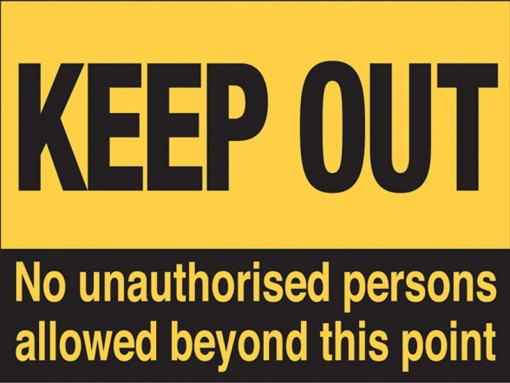
Image: Sign artifact from Weitzman National Museum of American Jewish History, Philadelphia, PA

Thursday, July 28, 2022

Narcissism – The Extreme Ego


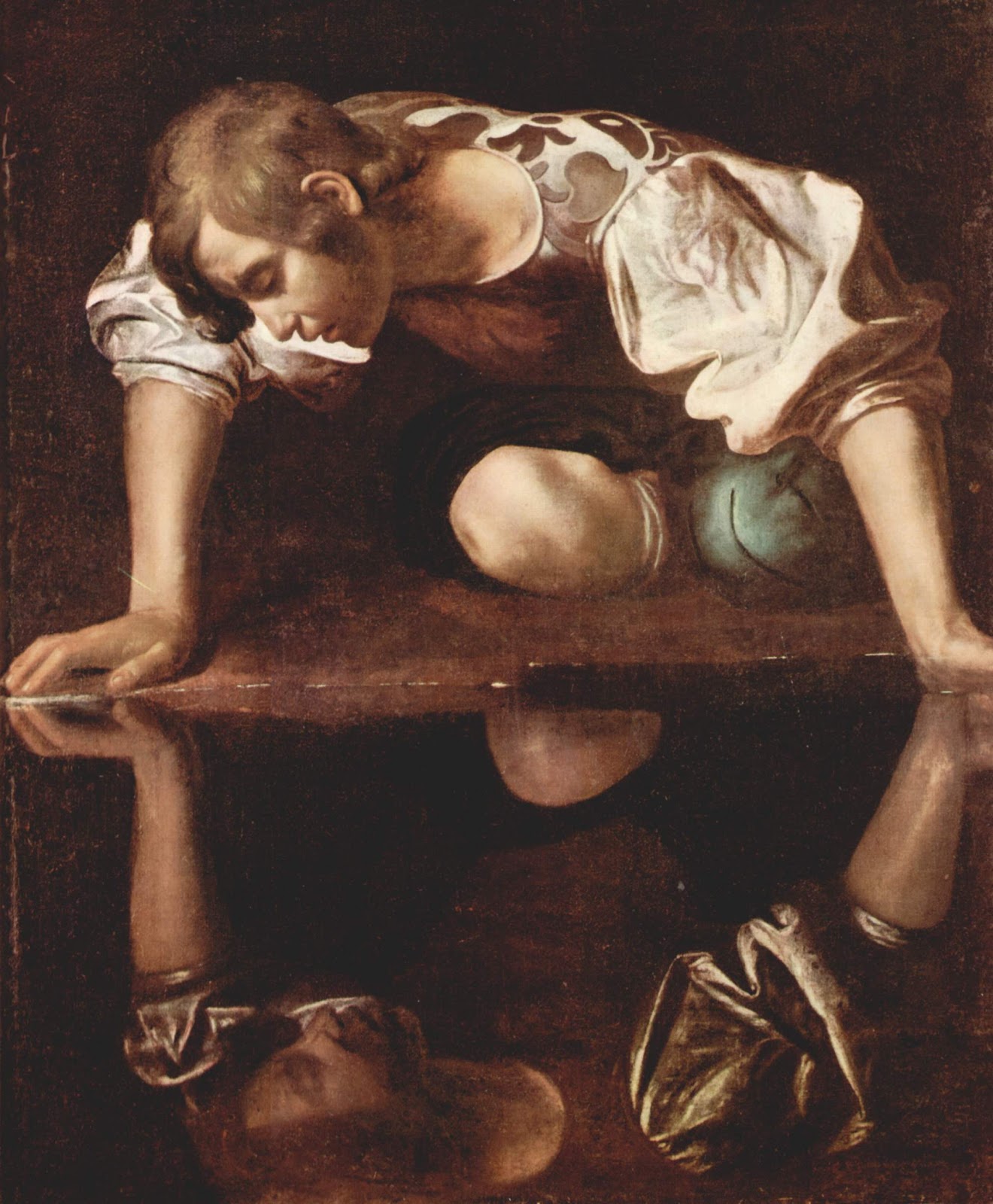
                                                                                        Narcissus,  by Caravaggio *

“The main condition for the achievement of love is the overcoming of one's narcissism. The narcissistic orientation is one in which one experiences as real only that which exists within oneself, while the phenomena in the outside world have no reality in themselves, but are experienced only from the viewpoint of their being useful or dangerous to one. The opposite pole to narcissism is objectivity; it is the faculty to see other people and things as they are, objectively, and to be able to separate this objective picture from a picture which is formed by one's desires and fears.” ― Erich Fromm

Homo sapiens is a highly sociable species, matched only by baboon society.  This requires an act of ego management, balancing our individuality against our equally important needs for other people—their knowledge, skills, attention, and cooperation (see “The Social Paradox,” June 2022 blog). 

Human life is an ego-driven endeavor.  But it is an equally cooperative venture, with reciprocity at its core.   This is the grand paradox of the human mind—it is exquisitely tuned into itself, while at the same time, occupied with understanding the minds of others. But at the extreme opposite end of the balance board is the narcissist, named after the figure in Greek mythology who fell in love with his own reflection. 

Narcissistic Personality Disorder (NPD) became a personality disorder (in the diagnostic directory DSM-5) starting in 2013. Estimates are this describes one percent of the US population.  However, the other 99% struggle with the symptoms and proclivities of the disorder. Most of us can build the bridges needed between ourselves and the reality of other people.  Those who cannot do this risk crossing over into sociopathology, with its inability to recognize and empathize, and feel the effects of guilt, pain, and remorse when actions and intentions harm others.  It is the dark danger zone of being human without a conscience.

The basic divide between NPD subjects and the rest of us is social intelligence – containing the ego just enough so that it doesn’t transform into sociopathy.  Many successful leaders have the disorder.  We stand back and let them operate by the rule of ego – it simply isn’t worth our own standing and reputation to oppose their willfulness.    Famous narcissists fill the history books and current news – Nero, Napoleon, Hitler, Trump, Mao, Mussolini.  Narcissism involves manipulation to control others without taking responsibility for outcomes (and so lack of deep relationships), projecting blame onto the world while denying any defects and believing oneself to be high-achieving and super-intelligent in a lived-out fantasy of grandiosity and invincibility.  Facts are no barrier when reality can be overcome by the forces of personality and self-promotion.  Lying, justifying, and promising unrealistically are common activities.

 Beliefs and behaviors:

Delusions of grandeur, with fixations about personal power, intelligence, and attractiveness.  These delusions are taken as reality, with real or imagined associations with status and others with status, requires continual admiration and attention.  Expectations of special treatment and subservience, most often achieved through manipulation and exploitation.  Unable or unwilling to empathize with others, without guilt or conscience.  Envy of others’ status and achievements.  (Degges-White, Psychology Today, 10/25/21)

 Causes:

Either childhood abuse or pampering; idealization about abilities and potential by parents; unrealistic expectations for achievement; protection from normal consequences of bad behavior (the “free pass”), creating an attitude of entitlement and special treatment. 

 Treatment / therapy:

Giving them the attention they crave and “deserve” doesn’t work--only feeding their appetite and adding to the black hole that is their need for admiring attention.  There is no tolerance of criticism (including therapeutic inquiry) and no way to let go of the toxic premise driving the disorder. Indeed, sufferers are by definition unable to conceive of themselves as needing help--except to get whatever they want. “A terrible prognosis,” as one psychiatrist put it, is the result of resistance to change because the NPD self-image is an immovable concept.  Those surrounding the subject—recipients of their abuse--are most often the ones who need and can respond to therapy.   

 Self-Defense:

For the rest of us, a narcissistic lifestyle alienates everyone, driving family, friends, and employees away because of the stress and time / effort demands of the forced attention and adulation.  The only therapy for those who can’t avoid contact is self-protection. This consists of setting boundaries, with clear expectations of respect and care for others.  Resistance is futile; fighting and arguing simply reinforce that the person is “right”-- therefore you cannot be.  All this takes calculation and energy, with its draining effects of stress, uncertainty, and continuing conflict.

Because the nature of narcissism is that its sufferers aren’t self-aware about their condition, in its pure states, this a mental health disorder without a cure.  All they know is that they want and deserve to be unconditionally admired and catered to.  This is the universe built around a serious personality malfunction.  Which doesn’t serve them well unless they are the ultra-alpha leader (like Putin and Trump) who never has to admit they are not the top dog—because they are, and in a position to prove it.  Nothing really disturbs their self-image, which means they can afford, as a psychological reality, to live the NPD life. 


*Narcissus (1597-99), Caravaggio - The Yorck Project (2002) 10.000 Meisterwerke der Malerei (DVD-ROM), distributed by DIRECTMEDIA Publishing GmbH. ISBN: 3936122202., Public Domain

Monday, June 20, 2022

The Social Paradox


                                            Image by Pexels from Pixabay

“Man is a social animal.  He who lives without society is either a beast or God.”

                                                                                                 – Aristotle

Part I

What do we spend most of our time background-thinking about?  Most of this rumination has to do with our social ties: where they are, where they are going, what could go right with them, what could go wrong—the source of much anxiety.  Most of our important conflicts are between family members, because the stakes in close relationships are the highest.  The people closest to us are the main source of help and support—the source of the traditional family business.  Altruism starts at home and largely locates there for the human lifetime. 

Social rumination is all part of our intensely social nature as apex primates.  Human nature has two faces, and they seem opposed in a paradox: while we are intensely social, we are also intensely territorial, and spend time thinking about where our boundaries are (our reputations, our holdings, and wealth both material and social) as well as how well those boundaries are working—or being challenged--in the social realm (see “Territory” blog, February 27, 2022).  For a consummate review of territoriality, see Simon Winchester’s Land: How the hunger for ownership shaped the modern world, (2021).

Why are primates such social creatures?  This is the leading inquiry among primatologists.  How do we operate as social beings, going beyond our individual boundaries to create, manage, and transfer thinking and behaviors across generations?  Ever since researchers sequenced the chimp genome in 2005, they’ve recognized that people share about 99% of our DNA with chimpanzees, making them our closest residing relatives. This raises the question of what chimp behavior have to say about ours?

Animal researcher Edward O. Wilson sees social behavior, the product of evolution—sociobiology, as the best collective adaptation for survival and reproduction for the group. As an old saying goes, “One monkey is no monkey.”  Paleoanthropologist Daniel Lieberman identifies our intense social nature to be the root of our uniqueness.  “Humans are intensely social creatures, and more than any other species, we cooperate with unrelated strangers…. As a result, we have been elected to enjoy doing activities in groups, to assist one another, and to care what others think of us” (Exercised, 2020).   

Viewing human life and goals as a system of organized thought and decision-making opens new lines of observation and experimentation beyond but including individual biology, brain, and behavior.  The key to culture is its uncanny ability to balance major forces like self-centered instincts with our ability to socialize with people outside the family bond: in religion, cities, professions, sports, government, the military, as well as across generations and clan relatives. 

Complex social organizations, as well as language, make every social level and effort a set of rules and skills that contain power and leverage influence.  They enforce the rights and reputation of individuals who worry about losing social footing and rank in any given group.  Our constant rumination about our place in the hierarchy mediates between building status in our competitive careers and holding on to our place in the many lines we maintain throughout a lifetime—while being generally cooperative and open to new alliances.

Part II

The individual personal space, and the many social spaces we inhabit in the course of living, do have something in common with fierce territorial impulses.  The paradox in this duality is that in order to be properly socialized, the first step is to be in control: the neocortex--upper brain--and its executive centers must be developed and in control in all social encounters.  This involves hundreds of limits we unconsciously observe even in the briefest of encounters. In other words, in order to be a social creature, you must have territorial awareness. 

What does this awareness entail?  First of all: boundaries.  Knowledge and respect for personal space, our core territory.  We are supremely sensitive to spatial invasion by other people, so that every social encounter must abide by the spatial separation.  Break this rule, and it’s over. Focus on the other speaker – eye contact, body language literacy, appropriate signals that show understanding.  Language compatibility.  Emotional focus and response.  Appropriate content—information revealed and hidden.  Voice register, pacing, tone, and allowing for alternative speaking. In other words, quickly changing awareness of person, place, purpose, and proceeding in any situation.  Language level, status and role, age, class, and gender markers all operate within the context.  It’s much for the mind and the emotions to handle, besides the conscious awareness of past, present, and future repercussions of whatever is said and replied to.

The ability to understand “theory of mind” – knowing how others think, feel, and act, and the rules of engagement.  This covers not just basic manners (knowing if and when to speak, how to ask questions and offer information), but how and when to reveal personal information, and what specific contexts require or prohibit revelations.  The life-long learning that humans undertake is largely about how to start and maintain good relationships, how to note and repair damage to them, how to connect others in our lives (or keep them apart), and discover our unique talents in conversation, presentation, leader- or follower-ship, as well as what situations and people we are better keeping away from. 

All these skills must be constantly honed and refined, shifting with thousands of situations, some familiar, many unknown.  It is a genius-level undertaking.  Yet all of us do it every day--with astounding virtuosity.  And how is this all learned?  Through experience, not so much through tutoring.  From a high-stakes court testimony to a casual hello in the company hallway, we learn mastery, and creative, unique responses, to whatever emerges next—whether in person, on the phone, or in writing. 

Although we are intensely sociable, we save this intensity for a defined circle (see Altruism blog, May 30).  We are particular about who we spend our time with—and that time is increasingly shrinking.  The notable fact of human life is that we are highly social—only baboons approach our level.  At the same time, though, we are also highly territorial about how we mix with others on a regular basis.  The short list of our most favored contacts over time makes up the inner circle that revolves around the center---yourself.  This circle includes immediate family, close friends, close colleagues, religious and association co-members, neighbors geographically close, and friends-of-friends.  We are acutely aware of this list, as well as who else is around us and how aggressive they are.  This is why our limited time is also spent in avoiding or placating those unfavored many who would like to join our list but who we determine are simply not worthy of protracted time and attention.  Of course, each of us is also on the “do-not-admit” lists of many people we aspire to be closer to. 

Technology is now taking over times and places of the more expensive in-person events everyone cherishes but few have the time budget for anymore.  With the number of distractions now available plus the constant phone and computer streams, we have a wider circle but shallower connections.  Think of play dates, breakfast meetings, and zoom conferences, and the infamous low social skills of Millenials and Gen Z.  There are reasons we have become even more picky about who we let into our inner circle and the time budget for each.  Like all human activities, our social lives are on an agenda limited by time, travel, work, leisure, and every other demand.  Covid has reinforced these limits so as to make them more acceptable as a ticket to opt-out.


Image by Pexels from Pixabay


Friday, May 27, 2022

Altruism: Charity begins at home


“Natural selection is conventionally assumed to favor the strong and selfish who maximize their own utility function.  But human societies (hopefully) are organized on altruistic, cooperative interactions.  -- Peter Erdi, Ranking: The unwritten rules of the social game we all play (2020)


The cooperation of naturally selfish people is a form of indirect reciprocity, the process of banking social credits in an investment fund that will eventually build to pay off for favors paid to others in present.  This is a lifetime campaign of building a reputation for helpfulness, helping to build a reputation for altruism that will raise the chances of receiving help for oneself.  Whether this help comes from those you help directly, or from their relations, friends, and allies, doesn’t matter.  “Reputation helps trust to emerge among people” (Erdi, p. 163).  Acts of backing other people in their efforts are often public, not isolated but visible to the wider group, either as gossip, news, or legend. 

Perhaps the most famous act in the Western civilization is the crucifixion of Christ, with the enormous payoff of saving every soul that ever existed—with the proviso of having to acknowledge this sacrifice in order to benefit from it. At the other end of the scale is the mother-child dyad (the core concept of the cult worship of Mary).  This form of altruism drives our history generation by generation; life without it would not be possible. The largest unpaid labor pool in the world is that of child and home caretaking ($10.9 trillion worldwide, minimum wage, Oxfam estimate 2018).  Add to this the assessment of the emotional labor involved—the management of social relations in family groups nearly always performed largely by women and more difficult to price on the market.

We are constantly operating across the lines of the personal and private--think of the way language works for us—the basis of culture, our shared “reality by common consent.”  Altruism, investing in others in the long-term for mutual benefit, but at a loss in the present—is seen as uniquely human beyond the parent-child instinct, and one of our finest impulses.  Fossil remains focus scientists on the individual, but don’t reveal the story of our interactive character.  Our social history is based on the robust ability evolved to relate to each other’s needs in order to build the social structures that make us human in the same way walking upright does.  Part of this social structure is hierarchy; the ranking system that drives the way we are regarded and how that regard drives our opportunities and decision making.  Currently, in a move to install diversity policies in the workplace and professional groups, “allyship” has become a way for senior workers to share the value of their own reputations by promoting diversity candidates for hiring and moving up in the organization.

This is the realm of reputation.  Politicians, governments, countries, nonprofits, academics, scientists openly compete against each other for reputation points; it is the basis of brand identity as tied to quality and values.  It also serves to promote altruistic behavior, or at least its appearance.   

Researcher Jane Goodall was first to observe chimpanzees in the wild for as long or in as much detail to discover that her subjects were tool-users, that they were not vegetarians but omnivores, and that they cultivated learned practices like cracking nuts with stones and twig-probing for insects, even making stone tools.  And that they hunt, as an organized campaign, feasting on other animals, including other primates. 

These primate behaviors seem to verge on culture as learned behavior from individual to individual.  In the case of organized hunting, for humans, this practice began to differentiate by gender, age, and ability, as forays away from home and children began to reinforce the roles of hunter-away and caregiver/nurturer-at-home.  The two roles are complementary, and of course, therefore different and contrasting if not conflicting.  Male and female roles each have aspects that cost the individual energy and freedom.  But group survival and gains in well-being (health and longevity) benefit.  This is an example of using what makes us different as a type of capital that only certain social roles are able to access and apply.  Worth, competence, and influence—in one’s special role--are forms of capital to be allocated to various campaigns in which our group specialization can mobilize a move up the ladder of reputation.  We do not need to be martyrs to do this, but this is the symbol that comes to mind for extreme cases of social sacrifice. 

Behavior aimed at helping others seemingly disadvantages the altruist while advantaging the recipient.  But altruism can also be considered a form of long-term alliance we knowingly invest in, knowing the rewards take time to develop or be reciprocated.  Prolonged childhood caregiving is required to raise babies to adult social maturity, at age 18, compared to gorillas at age 10 and monkeys at 8.   This long primate socialization time is the outcome of just how much needs to be learned across a great many situations, and the volume of applied knowledge is largest in humans.

Apart from occasional acts of assistance to strangers and periodic aid to friends, intensive altruism is directed primarily at relatives, which is the reason kinship has always been so critical first, to determine, and then to nurture.  According to evolutionary biologist William Hamilton, the social evolutionary benefits of altruism outweigh the costs to individuals, increasing the fitness of their own genes by supporting the welfare of close relatives, and forming the “selfish” genetic base of altruism.  The math works like this: “[By genotype] we expect to find that no one is prepared to sacrifice his life for any single person, but that everyone will sacrifice it when he can thereby save more than 2 brothers, or 4 half-brothers, or 8 first cousins.”

Especially for baboons, macaques, and chimps (and humans), who live in “natal” groups, the group they were born into.  Defense and aggression for all these species form around the idea of cooperative defense of territory, the home base and the close relatives who make up our core community.  (Note how often the home base for seniors gets determined simply by where grandchildren live.  It is the leading reason for grandparents’ relocating.)  Now long-term care of parents and other relatives is raising the cost and duration of altruism beyond historical limits—another legion of unpaid caregivers.

Certain groups are so socially attuned and cohesive, for example Japanese, that the US government deemed this cohesion a threat to national security during the Second World War, leading to detention Executive Order 9066 in 1942.  Their accusers pronounced this ethnic minority one of “extraordinary cooperation and solidarity.”  Social identity rules, which include altruistic value promotion, operate to reduce conflict as well as uncertainty within the group.  But they also work to define the group against every other, which is the platform of identity politics based on values, lifestyle, and their partisan battles.  

Sunday, May 1, 2022

Topophilia: Love of Place


“Our genius is topophilia.” – M. R. O’Connor, Wayfinding

We are creatures naturally attuned to places.  From megacities to wilderness, forests to deserts, these frame our emotions and memories as nothing else can.  Our autobiographies—both body and brain—and our common human history have historically been shaped by the interface between us and the many environments we have made our home from the 37 billion acres of the earth’s surface (water makes up 90 billion more).  A third of this acreage is desert, a quarter is mountains, with only 1% urban—where half of us have now migrated to live.  In addition, tourism is a mainstay economy of much of the world’s states.

The past

“At the heart of successful human navigation is a capacity to record the past, attend to the present, and imagine the future—a goal or place that we would like to reach.”  In her reflections on our collective ability to move from one place to any other, in Wayfinding: The science and mystery of how humans navigate the world, M. R. O’Connor has explored difficult and remote territory herself: the Arctic, Australia, and Oceania.  Her mandate was to observe the way in which traditional cultures have adapted to the challenges of extreme weather and trackless terrain through inherited traditions of living with the land.   

The present

Both brain (focused on the hippocampus) and body have amazing coping mechanisms for doing this.  Including systems that take over our age-old perception and attention—beyond the intuitive skills of animals—that got us from one location to another and back for millions of years without maps or compasses.  The GPS revolution that has taken over the world so quickly has altered forever the way we think about travel and make our way around the world. For one thing, in the name of efficiency GPS orientation has limited the discovery and insight inherent in simply wandering and exploring for their own sake.  O’Connor’s exploration into the traditions of the pretechnological age see how they influence “looking at the world and thinking about space, time, memory, and travel.” 

The human ability to change environments instantly through jet travel or over thousands of years on our mass migration out of Africa is the background to our love of places, or topophilia, the term of the Chinese-American geographer Yi-Fu Tuan.  I had the fortune of studying with him for a semester at the East-West Center at the University of Hawaii years ago.  Tuan had a keen curiosity about the human/place relationship, including mental maps, memory built up as episodic journey narratives, and nostalgia for times welded to places.  These connections are the basis for re-creations in the hyperreality of theme parks.  The country’s most famous Main Street is a setting in the Magic Kingdom(s).  In the book of the same name, Tuan explains his concept: 

As a geographer, I have always been curious about how people live in different parts of the world.  But unlike many of my peer, the key words for me are not only “survival” and “adaptation,” which suggest a rather grim and puritanical attitude to life.  People everywhere, I believe, also aspire toward contentment and joy.  Environment, for them, is not just a resource base to be used or natural forces to adapt to, but also sources of assurance and pleasure, objects of profound attachment and love.  (1990 ed., xii)

“Navigating becomes a way of knowing, familiarity, and fondness.  It is how you can fall in love with a mountain or a forest.  Wayfinding is how we accumulate treasure maps of exquisite memories.”  (O’Connor). 

Observing closely and thinking deeply about our many environments, and the ways we navigate them, is a key to self-knowledge, identity, and appreciation of how we interact with the spaces and places that shape us and our individual identity.  (Winston Churchill noted that we shape our buildings, then they shape us.)  In my own South Philadelphia neighborhood, long called the Italian Market, is changing in its look, feel, and population by the month.  It is a different place from the one I moved to in the early 1990s. 

The nature of my attachment to this place—my rootedness—is subject to this transformation in economics, taste, generations, and class mobility—the factors that define where we live and why we live there.  As pricing, neighbors, politics, schools, and style move far enough away from their origins, moving to another place becomes a real option.  “Being at home” in the world connotes comfort, safety, a hopeful future, and a real love of place—or else where our home is must change.  The nation is seeing sizeable shifts in mobility coming out of the Covid experience. Shifts in circumstance, even technology, evoke changes in the way we see our values reflected in our home base, the core connection to place.


Wednesday, April 6, 2022

Navigating Medicare


The problem

The end of each year brings over two months of insurance reassignment, the “open enrollment” period.  This is in addition to the regular nonstop Medicare signup as everyone turning 65 signs on to thousands of Medicare insurance programs.  Not just over-65s, but low-income (Medicaid), plus disabled, are eligible.  Four additional months of the year (ending March 31) are hunting season for Medicare Advantage plan-changers. 

Half the time the phone rings, that’s what’s on the other end: an invitation to enter a bewildering universe of costs and options without any rational or obvious route to navigating that world. 

This national decision-making marathon is the natural outcome of the “customer-first” trend in medicine.  And while that sounds empowering, it actually means that healthcare customers are increasingly responsible for decisions well beyond their education level or even their ability to ask for and organize information in strategic ways.  This goes along with being required to select treatments and compare risks, decisions for which patients have no training. 

Decision making

Decision-making science is an education in itself, and even when they are aware of the basics, few people can implement this skill in any systematic way.  Rather than rational procedures with principles and guidelines, most major decisions are 95% right-brained, emotional responses to hoped-for results to get a compound-complex process over with.

For most people, we understand pieces of the puzzle (but not the entire system) and just have to hope it all comes together for our future quality of life, health, and finances.  This is a poker game we know very little about when it comes to high-stakes betting.  What’s important is to distinguish between critical and less-critical decisions within the game.  And a good sense of probability calculations.  As Charles Duhigg puts it in Smarter, Faster, Better (2016), “How do we learn to make better decisions? .....Regardless of our methods, the goals are the same: to see the future as multiple possibilities rather than one predetermined outcome; to identify what you do and don’t know; to ask yourself, which choice gets you the best odds?” 

The options

What do the puzzle pieces look like?  Costs include premiums, deductibles, and copays, both within and outside the Medicare system or the Supplement or Advantage plan under review – and compared between plans.  Then there are all the time frames that define when care can be given, how often, and in conjunction with other treatments, along with any follow-up care.  Where will services be available?  Locations, clinic type (there are several, ranging between in-patient hospital, emergency centers, offices, urgent-care, ambulatory, observational, etc.).  Then post-procedure stays, long-term care for chronic cases like long Covid (which will be an upcoming major line item in the decision tree as a disability), at-home, nursing centers, and more. Watch for important exclusions and limitations in services, cost, and scheduling. 

Solution-seeking

Basic keys

These are led by three: does the potential plan cover my current providers?  Does it cover my medications? (Average is $1200 spent per year).  What will it cost or save—compared to what I pay now (premiums and copays)?  These are big-ticket decisions whose consequences usually become clear only after choices are made, procedures undergone, and the bill arrives.  The choice of insurance plan amounts to a critical partnership between the patient and a complex system that can’t be understood in advance of billing outcomes—when it’s discovered that your procedure wasn’t covered, or is attached to services uncovered. Sitting in the dental chair about to be fitted for a molar crown is no time to be told that porcelain is an extra $300. 

In parallel, when Mom’s health starts to fail, millions now realize they don’t really understand the full rulebook for her long-term care policy.  The percentage of long-term care payers who ever use their insurance is far less than half. Plenty of anguish and suffering results from failure to make the right choices, and that depends on getting good decision training.

The number of decisions, based on the Evidence of Coverage, is simply overwhelming.  There is no way that anyone can foresee what services and procedures and drugs they will need, even for the near future.  And quite difficult to construct equations that can show parallels between plans, as each line item can differ in coverage or scope as well as cost.  Is it better to have a higher deductible (copay) for a hospital visit, or a lower one with fewer benefits?  This is one example of the difficulty of comparing unequal line items.  And then there are dozens—hundreds—of other comparisons the customer can try to make without fully understanding what is being compared.  At the bottom line, there is a confused list that doesn’t carry over to rank two or three or four plans.  That means there is no confident bottom line for price—or for coverage, either.

Brain basics

Prospect theory says that we are more afraid of losses (about 2.4 x) than rewarded by gains.  Any single difference changes the equation; it can take hundreds of hours to puzzle out. This includes understanding what you don’t need to buy—expensive extras or guarantees that increase the bottom line without adding any value.  Does the monthly cost of a hospital indemnity plan (at $30-$60 and up) actually justify the expected hospital stays?  The actual number, of course, is an unknown quantity. 

You only find out how good or poor decisions were when the medical incident strikes and you need to use it.  Things will be fine—until they aren’t.  Either you can’t use the plan or what you need costs more than expected—sometimes thousands more. But hindsight is a hard way to learn. You need to know what obstacles could be involved in advance, and how to navigate these when they emerge.  This takes a sophisticated, experienced decision partner to review the options.  Pitfalls aren’t visible until you are falling into them (that’s their purpose).  Your new formulary may charge you $500/month for a drug that was free under the plan you had last year.  Providers change plans (your doctor could be one of them). And the plan you have now can always announce changes for next year—including their brand names, which leads to more confusion. Over half of the adults in a Bloomberg survey on debt reported that healthcare costs were the leading source (led by emergency-room visits), at over $10,000 for one in four.

There is an essential fact worth keeping in mind here: humans don’t like making decisions--under any circumstances.  Especially for high-stakes issues with complex rules we can’t understand or know how to apply, in a field based on medical, high technology, and complex financial systems. Once executed, the choice can’t always be reversed or undone in time to prevent costly further decisions.   Add this uncertainty to our ignorance of accidents and illness in the future. Decision avoidance could keep us from making very logical changes to coverage we now have but don’t understand at all well until we need it—and this unfamiliarity itself encourages active avoidance.  Ongoing discomfort with low Medicare understanding can result in ignoring the Open Enrollment period, just when choosers should be wading into the change process because their health and finances could benefit.   

Navigating the system

How do Medicare insurance plans advertise?  Each year mailbox and email are choked with flyers about supplemental benefits: health clubs, cooking classes, transportation, delivered groceries.  OTC allowances and home nurse wellness visits are largely diversions, a form of emotional window dressing.  These are actually the most immediately compelling and likeable features by which private insurance advertises, because they are the most viscerally appealing, as well as familiar (yoga, steak, gummy vitamins) the easiest to relate to.  But they are not anywhere near the top row in the decision process, a reversal that puts them top of mind while co-pays, major surgery, home nursing care, therapies, screenings, and lab tests are far more costly and important.  Reversing the hierarchy is an example of a clarifying technique in framing this decision.

In fact the entire Medicare process is based on emotional appeals: opening with reassurance about medical systems’ “caring,” along with saving money, discounts, free stuff, glamorous retiree shots, and confidence in agents who sound smart.  They sound especially smart because they are dealing in technical domains – medical and technological—where patients have limited experience and knowledge.  So patients are going to feel undereducated, which they can’t help.  It adds to the attraction of leaning on the expertise of the seller while undervaluing one’s own ability to make sound decisions. 

But the outcome is high-stakes and high price, and will determine whether and how much quality healthcare is going to turn out to be affordable.  Not that different from buying a luxury car with hundreds of features and not knowing how they work or whether they are even needed or desirable, nor whether they could increase driving insurance rates or repairs.  The emotional hook of “luxury medical goods” must be pointed out and examined more closely so they can be overridden by a more rational computation.  It can almost seem that Medicare is designed to be confusing and unclear—it would be hard to think of a system of decisions that is more so. (See “Do You Know Your Medicare Number?  Try Memorizing This,” the February 2021 blog on the complexity of the Medicare alpha-numeric member ID making it highly difficult to memorize.)


Sunday, February 27, 2022

Territory


 “Modern man has conquered distance but not time. In a life span, a man now--as in the past--can establish profound roots only in a small corner of the world."

--Yi Fu Tuan, Geographer, Topophilia


We have not just one command central (in America, home is more an action center than castle) but a far-flung network from neighborhood to local, regional, state, national and international territories.  Based on our body and the personal space that bubbles around it, our own personal territory consists of our web of errands, work, socializing spots (like Starbucks, the archetypal third space), school, church, club, post office, health club.  Culture defines these spaces as well as the weak and strong forces that protect us while we are in them and between them.  Standing in line at the bank or pharmacy on one hand, along with military defense of national borders on the other, show an equal respect for territory.

Even our steady gaze at a museum painting establishes ownership of the space in between, and deters others from walking in front of us as long as that gaze continues. Intensive territories, especially the home, are protection and shelter, relief from stress, and a huge reserve of memory to draw upon that helps to create our identity and maintain continuity over time (Winifred Gallagher, The Power of Place).  The ownership, distribution, and applied understanding of the space and place require an entire cultural rulebook that is often just implicitly obeyed, above and beyond legal standards.  “Rather than relying on muscle,” Gallagher says, “we usually depend on law and custom to help us hold our ground” (187).  This cultural enforcement is the reason home invasion, or just a burglary, is so devasting—the entire citadel is transformed by the trauma in memory for all time. 

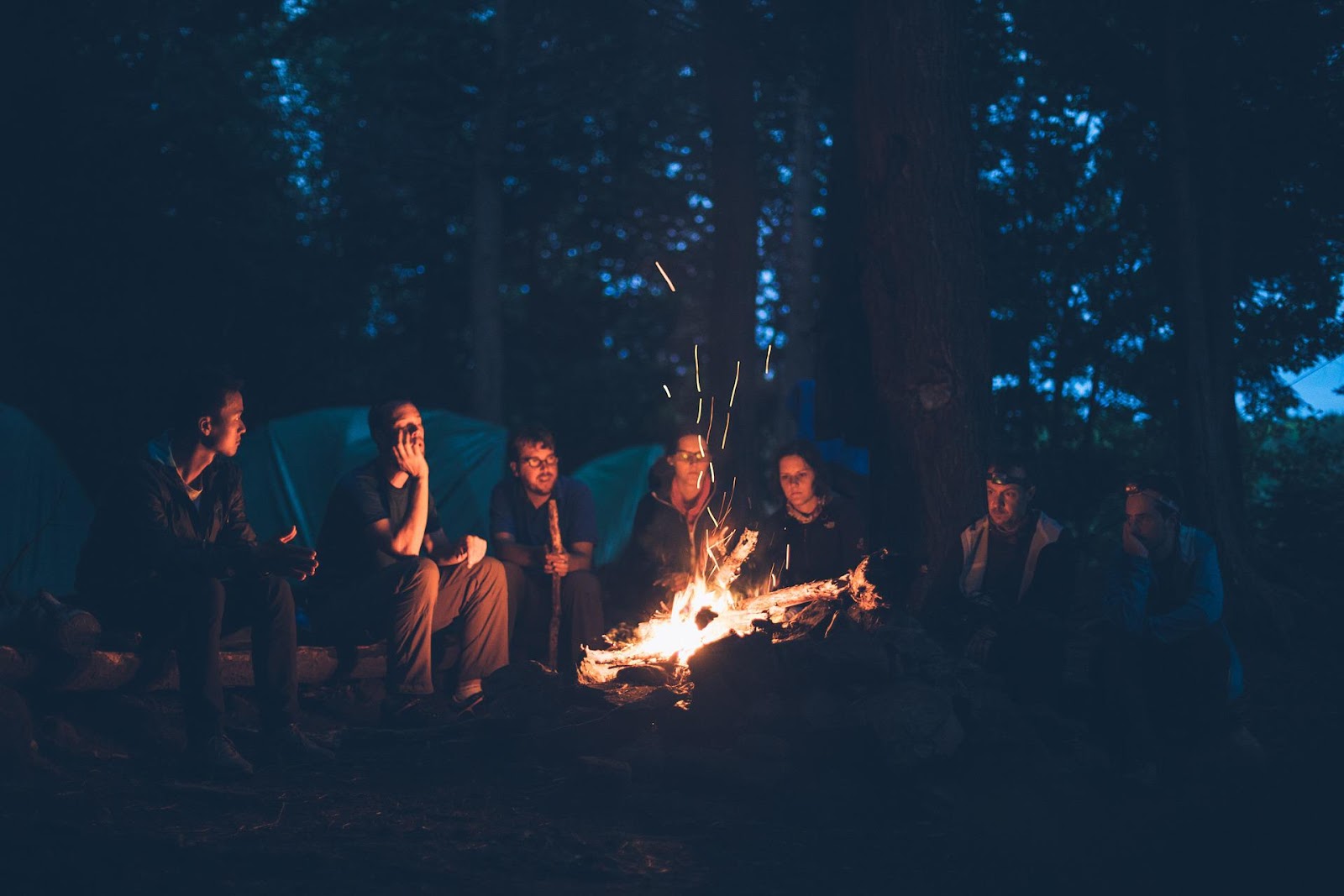
Establishing the concept of base camp for our early hunter-gatherer ancestors created a stable, safe, protected enclave, which allowed early people to venture out into the unknown and deal with their fears about new environments.  Our expansiveness was possible because the safe circle of the earliest campfire could become a symbol of security and the reassurance of a future anchored in the family and tribe.

Another factor was the basic space required to support human life based on meat as well as fruit, nuts, and roots: ten square miles per individual.  This number equals 300 square miles of range for a band of 30 people.  By contrast, baboons can live in a range of 15 square miles for 40, while howler monkeys need just a half square mile for 17.  Both apes and monkeys stay within their established range for a maximum of around 15 square miles of home range over their lifetimes.  Most animals remain in their home territory; it is nearly impossible to dislodge nonhuman primates from the place they grew up and learned through long experience.  Staying put backed by group defenses is a proven survival technique—until Man began the process of developing the desert, forest, and grasslands. 

This explains that once we ventured out of the African homeland, we quickly colonized the planet; we found a way of creating over and over again a campfire hearth that promoted ceremony, communication, trust, community, self-awareness with mutual support, an inviolable shared space—to build and maintain this “first zone” of cultural evolution. 

Human territorial history is the story of our species’ exploration and domestication of the planet, from cave-dweller to world domination.  We achieved this through cooperative group hunting of large animals, herd-following, tool and weapon-making, language, and division of labor between the sexes based on child-rearing. Exogamy—marriage outside the immediate group—and skill competition expanded the ranges of growing kinship groups as they sought more space and renewed resources. Refugee migration, much in the news, is an example of fleeing oppression as motivator. 

The mentality of belief reflects our wide historical range and personal space.  Belief is a form of territory claiming and defense in the abstract, a form of mental ranging, in a campaign of dominance of our ideas over others and other groups. We can hear it in expressions like digging our heels in, scoring yards, and ceding defensive positions. Our possessions (including land), as well as symbols like badges, flags, and signs marking out ownership and influence, are highly charged with the power of both defense and its naturally attendant aggression. 

M. R. O’Connor, in Wayfinding (2019), correlates our hippocampus health and grey matter volume with our cognitive mapping skills basic to navigating the environment. We have always been acutely aware of our territory: the limits to where we can go without the permission of others and what we are and are not free to do there.  The invisible limits of personal space as we move through our world – walking, in cars, climbing stairways, opening and closing doors, knocking, ringing, or clicking to win entry to old and new places – is a critical part of who we are and how we own or “lease” space shared with others, and negotiate an ongoing peace or conflict with them in the course of every day.  In fact, it is the learned experience of the rules of space—the culture of human geography--that make our social lives possible by avoiding the high costs of ongoing aggression.  Behind every activity (not just sports) is a rich overlay of conventions and contracts that have evolved to let us operate in space and time without violating the limits or ego or sparking group defenses.

The question of how people are able to build inclusive organizations requiring close cooperation while also preserving personal and kinship cohesion is one of the great paradoxes that makes humans unique.