Friday, February 2, 2024

Division of Labor: Excelling v. Extinction

    “When the whole man is involved there is no work.  Work begins with the division of labor.”

                                                                                                --Marshall McLuhan
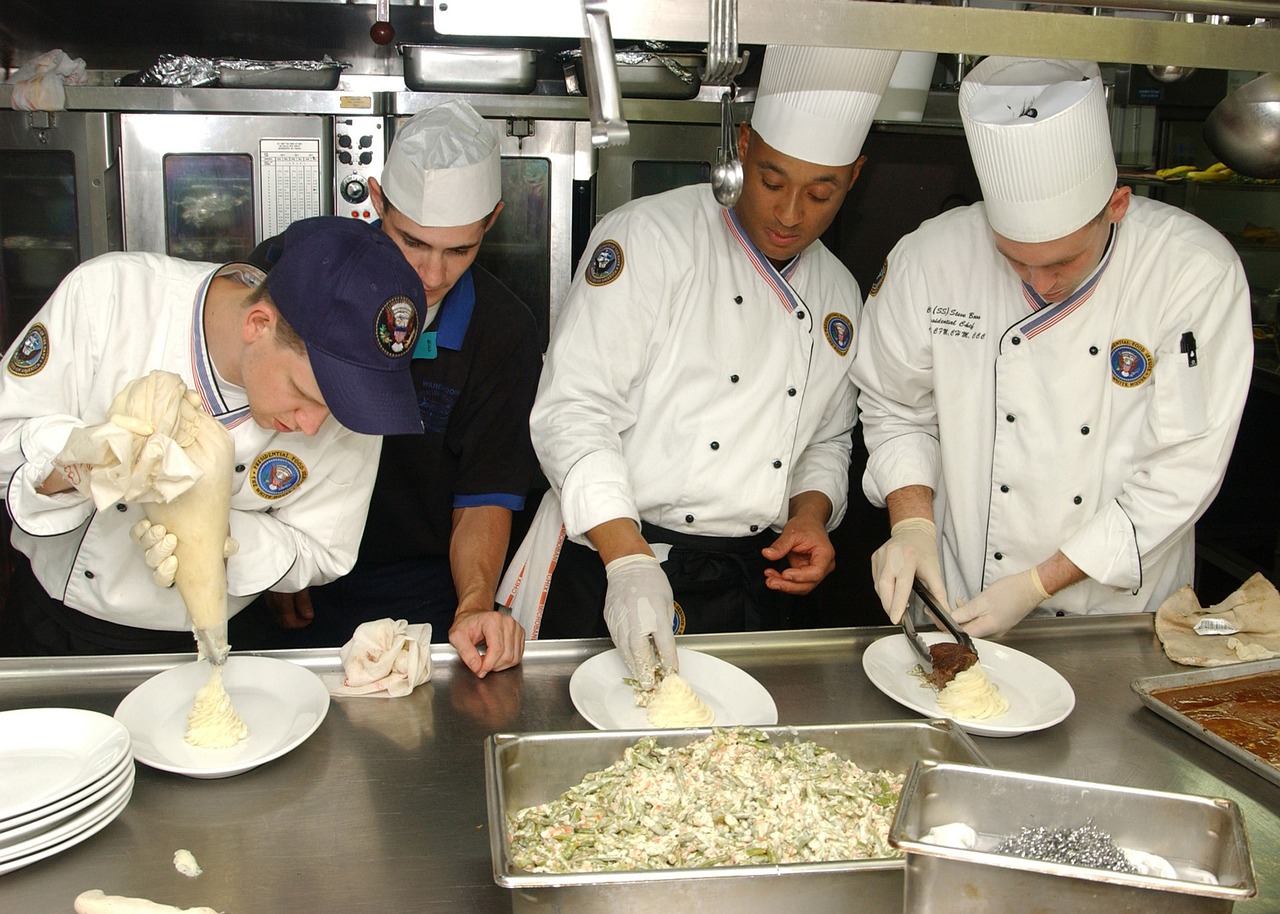
 

                                                                     White House kitchen staff division of labor

Economist Michael Kremer posed a cultural equation in which shared ideas, free as a public good, begin to be exchanged and grown across space and time.  As populations expanded, “more people, more ideas,” the higher concentrations gave rise to culture.

Over the centuries, population growth and technological change have expanded, including the division of labor (time and talent) that is the hallmark of the world’s great civilizations, marked by the growth of cities as wealth centers.

In fact, one of the great contrasts between the now-extinct Neanderthals and our species--homo sapiens--is this very ability.  Labor division allocates resources between those with differing skillsets and the time to learn and perfect them.  It is also what distinguishes talent in many arenas from those less talented, leading to status and class divisions. But the Neanderthal home showed no dedicated spaces there, nor any evidence of trading goods and behavior. 

Even their hunter-gatherer behavior seemed to be evenly distributed between men and women (Tim Harford, The Logic of Life, (2008) p. 208-09):  This original division of labor, between male and female, is quite ancient as a shared tradition.  “Today’s simple hunter-gatherer societies divide tasks between the sexes.  Men hunt big game and not much else; women hunt small animals, gather berries and nuts, make clothes, and look after the kids.  Early humans, too, seem to have divided jobs between hunters and gatherers, presumably along the same lines.  Neanderthals, apparently, did not.”

Nor do we know if they had language, indispensable to trading information between or within groups, and record-keeping of assignments.  Language and its concepts are essential to cooperation and role designation as well as task assignment.  The difference may be genetic. Reported in Science in 2022 (Sept. 9) is the discovery of a gene mutation in our species.  This mutation signals the development of extra neurons in the frontal neocortex that greatly enhance connectivity. This TKTL1 gene is lacking in all previous hominids.  Homo sapiens’ birth might come down to this single unique trait.

Division of labor is not as simple as dealing out work to be done equally by effort and hours, but applying the principle of diversity to project and process, both simple and complex—from building huts to bridges to cities.  Using the idea of comparative advantage, any group effort leverages the various capabilities within the group (the job of management expertise), including skills, age, gender, ability, experience, strengths, aptitudes, and weaknesses.  The project is taken apart with a view to splitting subtasks so that they can be assigned by talent as well as time. 

Expertise is developed as a cultural tradition: craft, battle, agriculture, hunting, exploration, planning, engineering, building, language, the arts.  Childcare and foraging were classical women’s work, whereas menfolk specialized in hunting, defense, exploration, and leadership.  Human resources is ideally the science of understanding human capabilities and allocating them in the most productive way (beyond just signing up insurance plans). 

The wealth of cities consists in their ability to instantly draw upon large arrays of these specialized traditions, putting these to work in organized group form.  Organizing human talent and skill, beyond just tool-making or invention, is the basis of any civilized order.  Even the division of domestic spaces designated for separate activities is evidence of thinking in terms of labor division and the special needs of any specific job.  From Egypt onward, homes showed the first-discovered spaces dedicated to leisure pursuits alone, diffusing throughout the human indoor landscape.  In the Neanderthal case, low populations, besides keeping cities in the future, also stymied the technological innovations that generate the cross-fertilized energy and growth of cities. 

Failure to think in this way might be the reason behind the fading of Neanderthals, our close cousins, as they become superseded by homo sapiens 40,000 years ago.  Harford speculates that this approach to working was not evident from the Neanderthal record. 

Division of labor was theorized by French social philosopher Emile Durkheim (1893) to correlate to the moral and communal power of groups to be productive and influential.  This mentality was the way humans were not only able to survive but to thrive as well as prevail.  Another expression of labor division is trade, sharing resources by relocation and speculation by importing novelty and specialization (a kind of cultural arbitrage)—evidence also absent from the Neanderthal record. 

Trade also underlies our social nature as a formalized endeavor between unrelated groups—a necessary parallel to the exogamy of marriage and mating between unlike genetic pools. “Computer simulations show that the propensity to track, barter, and exchange could easily have allowed humans to wipe out Neanderthals in a few thousand years, even if the typical Neanderthal was faster and stronger and perhaps smarter, too" (Hartford p. 208). While 99.7% of genetic material is shared by modern humans and Neanderthals—more closely related than chimpanzees—we diverged over half a million years ago from the last common ancestor.  The DNA record also shows evidence of incestuous mating in these late relatives.

And of course, these labor divisions are far from equal in either their demands or rewards, further dividing the merit landscape that says which groups can aspire to and occupy roles in the professions, politics, celebrity, athletics and in the arts, crafts, and letters.   When Americans meet for the first time, our first question is “What do you do?”  We are looking for clues to background, merit, aspiration, and status. We are, on the scale of world cultures, closely identified with our careers as an index to our background, class, and potential.  Our places in work role diversity are equally important a social index as ethnicity, education, and earnings. 

Thursday, January 18, 2024

Small Bias – Big Effects


We associate the term bias with “bias against,” but not so often “bias towards,” or pro bias.  But in a famous simulation by economist Thomas Schelling, it is the pro bias, or general preference, that can finally create an outcome of de facto segregation of housing. People feel more comfortable in the company of people like themselves.  It is not so much a matter of what they look like as how they think. Shared values, which in this case means a mindset of assumptions - values collectively accepted as true - trumps everything else, regardless of other differences.   

Here is the way this pro bias operates to create housing choice—where people choose to live based on what group the neighbors belong to, as described by economist Tim Harford in The Logic of Life (2008). 

People are happy to live in mixed neighborhoods until they are outnumbered 2 to 1, or one-third of the area population, using a chessboard as a model of an integrated society of households. As white pieces get too many black neighbors (and vice-versa), a wave of segregation washes over the board.  Chess pieces surrounded by too many of the opposition move away, and doing so consolidates a picture of black homogeneity and white homogeneity (p.111). 

This process of a simple rule about preference for living in a place not too dominated by the “other side” was first modelled by Schelling, a game theorist who wondered what kind of social behavior could be explained by game theory: what happened when a single person moved to avoid being socially isolated (Schelling won the Noble Prize in 2005 by pursuing this question). 

“Schelling’s chessboard models showed that all it takes is a mild preference against being too heavily outnumbered…. Pessimists would point out that his model suggests that extreme segregation is almost inevitable” (Harford, p. 115).  Some claim that as little as a 10% incursion by a different group is enough to launch an avalanche of movers away (“white flight”) and thereby toward a more homogeneous settlement.  By following the outcome of game theory simulations, we can see that final outcomes can be unexpected, unintended, and perhaps even less than desired by any and all players. 

Stanford Encyclopedia of Philosophy opens its definition of Game Theory with this statement:

Game theory is the study of the ways in which interacting choices of economic agents produce outcomes with respect to the preferences (or utilities) of those agents, where the outcomes in question might have been intended by none of the agents (Sept. 3, 2023 ed.).

What appears to be an anti-bias against those different from ourselves can be seen, at the same time, not as an inbred prejudice against those unlike us but as a pro-bias preference for living among those whom we better relate to.  Flexing the reward system for “otherness” into some sort of affinity for those unlike ourselves can dull or nullify the expected social effects of housing location, if these rewards operate within the value bias of the group.  Class can overcome race, for example.

College towns and tourist destinations display a greater mix of ethnic types based on a common bond as middle-class.  And at the Disney parks, an enclave of highly mixed types and origins, race is rarely an issue because the park is recognized as a safe space.  Gay enclaves are known for both mixing and stabilizing what were once lower-end city districts, because gays generally do not need to prioritize good school districts in their housing agenda. Their social lives also generate more public safety by keeping streets and bistros busy well into the evening. 

Harford’s book offers several related examples of large effects from small biases.  Some depend on time of day and weather. For example, public playgrounds such as Hackney Downs in London experience social swings from moms and their children during the day to the young male teens who move in to dominate after twilight. This incursion switches the family-friendly sunlit atmosphere to edgy and unwelcoming.  The social theme instantly transforms from warm to cold with the teen “negative externality” transfer.  The openness of public space means that more negative behavior drives out the genteel and middle-class ethic--the ongoing problem with "public" parks.

In the same way, a city’s preference for tall building blocks exerts a bias toward street crime.  How?  By limiting the effect of “eyes on the street” that keeps crime rates down by citizen surveillance and intervention.  In areas with eyes at street level, safety increases as more pedestrians are attracted in.  The safety bias is self-sustaining and positively reinforcing.  Gay gentrification promotes such busy, safe, and engaging street dynamics in a “positive externality.”  This is one reason the middle class, whatever its politics, does not mind gay neighbors--especially homeowners

Friday, December 8, 2023

Quotes on Magic and Science


There are thousands of quotable quotes associated with presidents, geniuses, educators, athletes, religious and military leaders, great builders, lawmakers, artists, authors, and actors.  But among these are certain quotations you know immediately to be false—my current favorite is “The problem with quotes found on the Internet is that they are often not true,” attributed to Abraham Lincoln.

Of course, that's an obvious joke - unlike a famous Gandhi quotation, “Be the change you wish to see in the world,” that is by many accounts a misattribution.  Yet the exhortation sounds impressive and true, because it embodies the truths and actions central to the man in his lifelong activist career. 

Truth value is contained in the context of the quotation itself, which can be judged to be off-center if it references the unknowable future or contradicts or compromises certified statements by the same person.  As humorous as Abe could be (and he frequently was), in no way could he have foreseen the advent of digital communication.  (He also said, referencing his homeliness, “Honestly, if I were two-faced, would I be showing you this one?” in the Lincoln-Douglas Debates of 1858.)

But there are cases less clearly resolved.  Just last month, Jamie O’Boyle and I presented in short form our findings on The Disney Effect, in honor of the centennial of the Walt Disney Company, at the Sixth TEAAS –Themed Experience & Attractions Academic symposium in Orlando, Florida. Part of our coverage was about the Disney branding Magic—starting with what magic actually means.  Among our citations was science-fiction writer Arthur C. Clarke, best known for his consulting on “2001: A Space Odyssey.”  In one of Clarke’s many media interviews, he is quoted as remarking “Magic is just science that we don’t understand yet.”


Here is where the quote-check issue arose.  At one of the seminar tables, a person or persons objected, raising doubts that Clarke ever made such a statement.*  A cursory search later on to review our sources showed a significant number of citations of this statement, including one on a T-shirt  My suspicion is that this critic was simply unfamiliar with this version of meaning, assuming it to be a misquote or falsely attributed--because it did not match the writer’s better-known and easier to find written quotation, his self-proclaimed Third Law, “Any sufficiently advanced technology is indistinguishable from magic.” 

Both quotations are freely cited online.  There is no misquotation or misattribution to be resolved.  (A misquotation, for example, would be “Money is the root of all evil,” instead of the actual phrasing “The love of money is the root of all evil” (Timothy 6:10, King James).  A posing as B.  But Clarke’s two quotes are clearly separate, consistent with one another, and neither is difficult to find. Clarke’s Third Law, his most famous, comes from Profiles of the Future (1973). The shorter, pithier one is a paraphrase by the same author that appeared in an Australian radio interview transcript also treating the future of technology.  Spoken word quotations may be harder to locate and validate than the written kind, but it is often possible.

However, there is another angle involved here.  Our presentation was not a literary study; we simply cited the “Magic” statement as a way of moving thought forward.  The issue is not Arthur C. Clarke’s output or opinions, but the idea of what magic might be and how it operates.  The citation issue must be considered a sidebar to the theme of the presentation.  This was the legacy of the Disney company and its innovations outside the parks, operating full force in the world beyond.  The quotations was never an issue germane to our presentation, nor is that why it was featured.  Sourcing and authenticity shouldn’t become a stumbling block to understanding.  It is the idea of magic itself and how its definition is constructed that was central. 

Perhaps the principle to keep in mind is not to believe everything you hear at a conference – at a table or behind the lectern - and especially not if the authenticity inquiry creates a buzzy diversion from the main topic.  Now if Arthur C. Clarke were a Disney Imagineer? That would be a different matter of fact-checking.  

The prolific density of Internet information also means a careful path to truth can be blazed.  So always double-check the source of your quotes and keep in mind those profound, albeit fake, words of Abraham Lincoln: “The problem with quotes found on the Internet is that they are often not true.”  

*Thanks to friend and colleague Kile Ozier for bringing this issue to my attention.

Friday, October 6, 2023

The Inheritance Talk: Why Money Mindfulness Is So Difficult--and Important


"The New York Times Advertising: T Brand Studio seeking a psychologist or sociologist who can provide deeper scientific context on why people avoid having financial conversations, especially the inheritance talk, why talking about money triggers stress and how to start having these critical conversations. We'll also talk specifically about the inheritance talk and why the lack thereof can cause turmoil among family members (Sept. 12, 2023 email).

"We’re never really taught that we have to think about our work before we can do it…Thinking in a concentrated manner to define desired outcomes and requisite next actions is something few people feel they have to do (until they HAVE to).  But in truth, it is the most effective means available for making wishes a reality." ---David Allen, productivity expert, Getting Things Done (2015)  

“The Baby Boomer generation is expected to leave a significant amount of money to their Millennial children. It's estimated that more than $68 trillion will be bequeathed to their offspring. The great wealth transfer is expected to make Millennials the richest generation in American history” (Forbes, Aug. 9, 2023).


Cultural values are the shared reality that drives perception, decision-making, and action (see my website below).  Wealth and money are essential to group well-being.  Wealth transfer between generations takes knowledge, talent, diplomacy, and a wide view of the interests and rights of others.  The stakes are high.  But few have the vision or practice to enter into negotiations with their parents as well as adult siblings that the inheritance talk requires. 

This is largely because money is one of the least-discussed topics in any relationship – less than sex, religion, or politics. Why? Because finances are a minefield of uncritical thinking, involving history, status, hope, regret, self-worth, and how we value our relationships.  This may be the reason that only one out of three people in the US have any estate plan or even a will.    

Abe Lincoln died without a will (despite being a lawyer).  He didn’t expect to be assassinated. Next century: Worth over $500 million today, since his death in 1981, singer Bob Marley’s complex estate (no will) has attracted dozens of claimants.  Jimi Hendrix likewise had an estate missing a will.  After his death in 1970, the battle waged over his assets continued until the end of the century.  Howard Hughes died in 1976 at age 70, again, without a will.  Although one was “discovered” at the Mormon headquarters in Salt Lake City, it proved to be a forgery.  Eventually the billionaire’s holdings were divided among 22 aides, charities, and former lovers.  (Source: LegalZoom.com)  

Family life operates by pre-assumptions—those habits of thinking that are unmindful about how things operate—especially around finances.  Very few families can be open and above board about how funds are managed or allocated. Even less-often shared is the rationale, the WHY behind HOW things operate—investments, expenditures, loans, savings, bequests, and long- and short-term goals. 

The Inheritance Talk needs to establish two things:  First is what the family has, and second, how these assets will be shared out--now and for the future when elder parents decease.  Both topics are hotbeds of potential conflict and confusion, leading to the need for clarification, correction, negotiation, and change. This is the time when assumptions are challenged and family secrets unveiled. None of these is anything family members seek out.  Nevertheless, The Conversation, freighted as it is with these perils, is essential to moving forward from past to future. 

This complicated talk about family money is far more than a meeting about numbers.  It can’t help being a judgment on the way Mom and Dad have handled—or failed to handle—assets and opportunities over time.  The discovery process is legitimate in its need to know how things stand and where they are headed.  Ideally, this scrutiny might go just fine, showing sound management over decades.  But more likely the close examination is going to reveal some flaws or possibly frauds—answering the question of why people are generally resistant to this audit process.  (We don’t like the IRS inviting us in to talk taxes, either.)  

Faults and inconsistencies will emerge, which means these can no longer be ignored or assumed to be unproblematic.  And financial arrangements between parents and siblings will come to light, raising jealously about favored compared to less-favored kids.  This is when you suddenly discover that the family house will not be sold and divided, but a caretaker child, or one cared for, has been given the right to live there indefinitely.

The Talk makes any assumptions clear and stays the ambiguity.  A common example of discovery is favoritism among adult children and uneven or strange-looking distributions.  Suddenly the actual operating assumptions showcase the unmistakable need to articulate reasoning, make fairness arguments, assign responsibly and/or blame, and press concerns about the future needs and rights of offspring (and surviving parents).  Now conflict avoidance is no longer possible, and the truth of things looms directly in the family’s faces, impossible to ignore.  It’s a moment of truth that often comes too late to save either feelings or finances.

This is why it is so critical to make things transparent all along, with the help of advisors, estate attorney, financial planner, or CPA and daily money manager providing counsel.  Many parents really do hope they will be spared The Talk and safely gone before having to do the right thing becomes necessary and unavoidable.  But the far better alternative is to get and keep the financial house in order long before that, getting everyone on the same page over time, through inevitable ongoing changes in the family picture.  Everyone is aware of this principle.  Few see full disclosure practiced.

Financial literacy, the ability to understand and apply financial concepts to managing personal finances, peaks in the early age 50s, when fewest mistakes are made.  This is the age when people have “accumulated knowledge and experience about money, spending and saving, but haven’t begun losing key analytic cognitive skills” (ARC Centre of Excellence in Population Ageing Research, Australia, 2023).  This means adult children are at or approaching their peak ability to read and repair the family financial landscape, while at the same time, their parents have passed that point and need help, whether requested or not.

In South Philadelphia where I live, I ran into a seventy-some man on his way to Italy.  His mission is to try to get in writing his ninety-some father’s promise of properties in that country under Italian law.  I wonder how that’s going for them?

Photo: Pixabay


Thursday, September 14, 2023

The Disney Effect – Themeatics


“Sixty years of crowd management has made Disney operations the undisputed champion of event control and coordination….If you’re serious about solving [your traffic] problems, you go to the Disney Academy at Disney World.”

                                                -- Phil McKinney, innovation expert, Beyond the Obvious, 2012

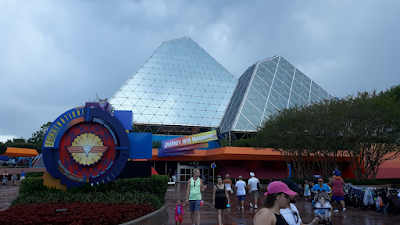
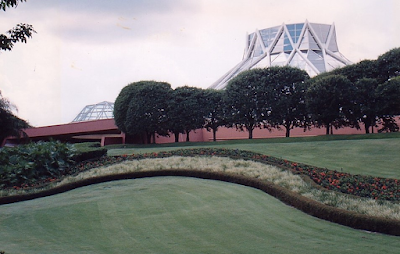
                                                EPCOT:  Journey into Imagination pavilion

Over the past century, the Disney Corporation has exerted an outsized effect on popular culture and the popular arts.  Disney 100, this year’s centennial of the company’s 1923 founding, is a timely point for taking stock of the “Disney Effect” across major cultural domains—especially in the domain of “themeatics. “

Since 1955 at Disneyland, the Ur-theme Park, the Disney model has guided design basic to the experience economy, acting as centers for creativity and innovation in the arts and technology, both popular and elite.  Themeing has been transforming public space in both design and use as enlargements of the sphere of entertainment far “beyond the berm,” most unforeseen and not at all calculated on the part of D-Co.  My career knowledge in themeatics (as I’m calling the aggregated skill set that created theme parks) can be put to work to take a measure of the far-reaching effects of this legacy. 

Themeatics is the unified field theory for the arts, as an artform that underpins design across fields from architecture to city planning to drama and audience experience to graphic design. Every aspect of the designed environment has been informed by the Disney Metropolitan Deco template. Around 150 artistic subfields, as a conservative estimate (by the late Marty Sklar as President of Walt Disney Imagineering) can be enumerated; and any artform ever devised, from ancient to state-of-the-art, can be seen within the fabric of the park design.

Walt Disney himself is considered a master innovator in the arts (all genres) and technology (high- as well as low-tech), with theme parks as the incubator enjoying a test audience of millions per month.  Far from Disney’s initial reputation as an animator (his true role was as a story editor and creator of the synchronized sound cartoon) and entertainer of the nation’s children with cartoons and audio animatronic rides, he headed a studio led by Imagineering (“imagination plus engineering”) that soon became a center for interdisciplinary creativity and innovation.  The outcomes transformed public space and the way it could be used, enlarging the entire scope and influence of simple entertainment. 

Central to this role was the development of hyperreality as the ultimate adaptable format for designing as well as experiencing art as a total-immersion, mixed-media, seamless experience.  Art and technology became permanently conjoined, using augmented reality (AR) from digital programs and applications, the basis of 5-D multi-media.  The outcome was environmental artworks, the most iconic being the theme park, aimed at brains and bodies of all ages. 

Hyperreality melds the real with fantasy and the subconscious so that these become indistinguishable in a new amalgam—as in the transformation of history on Main Street, USA.  As Christopher Finch put it in The Art of Walt Disney as early as the 1970s, “Disneyland and Walt Disney World are shows—a kind of total theater which exceeds the wildest dreams of avant-garde dramatists.”   Hyperreality is a concept in post-structuralism that refers to the process of the evolution of notions of reality, leading to a cultural state of confusion between signs and symbols invented to stand in for reality, and direct perceptions of consensus reality. Hyperreality is seen as a condition in which, because of the compression of perceptions of reality in culture and media, what is generally regarded as real and what is understood as fiction are seamlessly blended in experiences so that there is no longer any clear distinction between where one ends and the other begins. Hyperreality – established within the popular arts as well as the elite levels--works to integrate emotion, memory, rationality (as art history), and cultural values for both brain and body.

Culturally, at the theme parks, hyperreality acts as the enveloping artform to showcase themes important to cultural values for Americans; they express those values we most favor about ourselves and our national heritage: collective imagination (Fantasyland), our shared vision of the future (Tomorrowland), other people, places, and adventures important to us (Adventureland), and American history in Frontierland and Main Street, USA. 

At the theme park, the Disney Effect is an influence in entertainment and edutainment on all fronts.  Here the distinction between entertainment (as engagement) and amusement (as diversion) emerges. Disney productions and their methods are major instigators of the entire Experience Economy identified by Pine and Gilmore in 1999. 

Further, the Creative Economy, reflected in the Experience Economy, considers public space a closely designed and deliberate event-integrated vision--as seen in animation art. The Disney Imagineering team is cross-functional and interdisciplinary, a template copied across creative industries, for example in the use of storyboards to diagram character and action, an aspect of “blue-sky” open-ended idea generation.

The Disney legacy can be traced through the decades across a range of creative industries, tools, and technologies that inform the designed environment.  Theme parks in particular have become urban labs where concepts can be experienced by millions of visitors to test viability. 

Perhaps no other artform innovation approaches the reach, persistence, and inspiration as clearly as the legacy of this prototype.  Themeatics is a hyperreal mix of techniques borrowed from animation and filmmaking rather than architecture and urban planning: the familiar storyline, identifiable archetypal style, “not the design of space but the organization of procession” (architect Philip Johnson); stagecraft, iconography, special effects, audio-animatronics (3D animation), and color coordination, all led by the concept of “show” and “enhanced reality” (the late senior Imagineer John Hench’s term). Themeing is a tightly focused reality made to evoke specific times and places with strong cultural resonance. 

These distillations – from musical cueing and food to landscaping, lighting, scaling, signage, sound, surface, texture, and smell--play off perception and collective memory to create “instant moods.” These are achieved by motifs, layered detail (fractals), and multi-sensory environmental designs, favoring images over text to tell stories and give emotional direction. 

Inherent in themeing’s sense of place as a theater stage is the legacy of revival or nostalgia in latter twentieth-century design, and the multi-media assemblage of artforms and styles from many eras, traversing the evolutionary range from craft to high-tech.

Such a far-reaching and durable “Disney effect” was unintended and unanticipated; co-evolving with the unforeseen ascendence of virtual reality as a new default resulting in hyperreal environments.  The theme park model would recreate the real world both within and outside it, multiplying other worlds as themeatic offshoots.

            Journey into Imagination photo by J.G. O’Boyle

Monday, August 7, 2023

The Betty Crocker Legacy: A Century of the Homemaker’s Creed

                                 Betty Crocker portraits 1936 – 1996                       


This year marks the 150th anniversary of General Mills in Minneapolis, whose face since 1921 was that of the archetypal homemaker, Betty Crocker. 

Betty Crocker took shape after Gold Medal Flour ran a contest in the Saturday Evening Post with a jigsaw puzzle.  Along with the puzzle solutions, entries included questions from home cooks asking for baking advice.  Betty was created to provide answers from the staff of the Gold Medal test kitchen.  William Crocker was the popular company director who inspired the surname. Betty is an informal family-style name, but still traditional (nickname for Elizabeth, with Hebrew and English roots).  The World War II resonance (like movie headliners Bette Davis and Betty Grable) made a good naming level for a close family advisor in the kitchen that became a household name.


The interaction with the baking public was an early example of social media, sampling the public (now called crowd sourcing) as a way to do market research on women’s issues in cooking, and using that consumer input as the basis for creating the beloved advisor.   Answering letters was already a tool of the company’s public relations department, but generating a completely new character was innovative marketing genius.  New to the airwaves, the first radio cooking show was the “Betty Crocker Cooking School of the Air” on a Minneapolis station.  Today we would go to You Tube; in 1924, there was no television. Instead, families and friends gathered around their radios and, yes, because we intuitively look toward the source of someone speaking, they actually watched the radio when important news came on.


By the late 1940s Betty became one of the earliest brand icons on television.  Women after World War II had married in unprecedented numbers. With their husbands’ benefits from GI Bill, they could move into their own homes at an age unheard of before the war. Radio and later television, replaced their mothers as a resource for advice on how to manage the home and particularly the kitchen. What was called “Home Economics” (cooking, budgeting, and sewing your own clothes, among other skills) was still being taught in high schools well into the late 1960s.


Betty Crocker was already a star presence from her radio days. According to Fortune magazine, by 1945 she was the best-loved female figure after First Lady Eleanor Roosevelt. A considerable accomplishment for someone who didn’t really exist. She filled a gap in the homemaking pantheon.  Preparing dishes using packaged mixes was still not the norm (compared to cooking from scratch) and Betty was the link, informing the nation of the DIY aspects of processed and packaged recipes.


For young mothers operating on their own often very distant from their origin families, she was the trusted home-wise senior female always ready with moral support as well as mastery of how modern cooking operated.  This was especially vital during World War II, when rationing dominated the Homefront and ingredients were limited, lower-quality, or nonexistent.


General Mills produced a guidebook in 1945 called Our Nation’s Rations to help customers cope.  As a wisdom figure on a par with Walter Cronkite (“The most trusted man in America”), Dale Carnegie, or Eleanor Roosevelt, she emerged from the ranks of American wisdom heroes (embodied first by Benjamin Franklin).  These are practical problem-solvers with grace and integrity whose positive outlook is won through experience and shared with a broad public.


The Betty Crocker Picture Cook Book from 1950 is a perennial best-seller over seventy years later.  “The Homemaker’s Creed,” about the pride and talents of making the ideal home for the family, came out during wartime in 1944—just as women were being encouraged to return to the kitchen from the wartime factories where so many had been working.  The Creed pledge [of the Home Legion], suitable for signing, begins with “I believe homemaking is a noble and challenging career….an art requiring many different skills and the best of my efforts, my abilities, and my thinking.”  It was co-signed by Betty Crocker as the icon of American homemaking.   


Since her invention in 1921, she’s been gradually replaced by the secondary icon, the red cooking spoon, not a human icon with which anyone can identify.  Brand icons have two basic roles: they can either represent the product, or the product user.  Over the decades, after the 1960s, Betty’s image was steadily adapted to look younger and more cosmopolitan, as if she represented the consumer rather than the virtues of the product line itself.  The value proposition represented by Betty was rather the young grandmother with authority in the kitchen who knows what her customers want and the techniques to get them there.  She embodied authority and how-to inherent in the product.  A catch-phrase for her talents was “You can do it, and Betty can help you.” General Mills confused the two roles of the icon, meaning the Crocker image became less and less relevant for consumers when they saw a younger, less authoritative version.


Was Betty Crocker a real person?                                                                                                                                  


Not just one person, but a composite of several females originally drawn from the ranks of Gold Medal Home Service personnel.  For the 80s revision, 75 separate photos were aggregated in a single image.  The seven portraits from the 30s to the 90s all show closely ranging features and coloring, looking like female relatives (much as Disney animated princesses could be cousins).  In this way, the Crocker image was an early version of hyperreality applied to portraiture.  But that image is responded to as a living person: an adaptable, far-sighted, consistent, in-control figure inspiring trust and confidence. 


The Crocker image has had amazing cultural value – among the top 20 most recognizable images in the world (topped by the leading corporate symbol of Mickey Mouse).  Through seven transformations, from 1936 to 1996, she maintained her recognizable middle-American “ageless 32” image—in fact, she looks progressively younger in each, and by the mid-90s, has acquired a pan-ethnic olive complexion. In our research on the Crocker image, we found one consumer commenting that “the final image is no longer Betty Crocker, but Betty Rodriguez married to a Crocker.”


General Mills did not understand or appreciate that their customers did not want to BE Betty Crocker. They wanted Betty Crocker working for them in the kitchen. They were not identifying with the icon, but with the competence she represented – her skill as a baker who could turn out a perfect result every time.


This was the value center. It is an important distinction in marketing.  Companies are always looking for ways to update their images—however, dropping the persona of Betty wasn’t the way to do this (just as New Coke discovered in beverages). Companies often tire of their own images because they see them every day. They get inured to them, thinking them too old-fashioned and time-worn.  In fact, that is often their true value—think of the preppy themeing of Abercrombie and Fitch or Ralph Lauren.  These fashion lines show lasting profitability for their references to classic design, time-tested as trustworthy. In music, the late Tony Bennett trusted his faith in the classic American songbook that made him a lead performer well into his 80s.


After a century in media, Betty Crocker had become a fully vested American symbol of family, hearth, and home that many generations still treasure and look up to.  Her image is solidly emblematic of the middle-class, productivity, and women as homemakers. These are values steadily central to middle-class aspiration. To the company, Betty’s image began to recede as a symbol invested with the World War II generation, one that has now almost totally passed away.  Not its influence, however.


But Betty represented a stable and reliable universe, one on which you could depend. Consumers could rely on media figures not to make rash or selfish decisions, to hold the right values, to be principled and rational, and to speak with the voice of reason and moral authority around home and family. Most of all, despite her image updates, she presented constancy; you knew what you were going to get every time. Betty would never let you down.  We still need such icons in our lives—now more than ever. 


Photo: Pixabay